
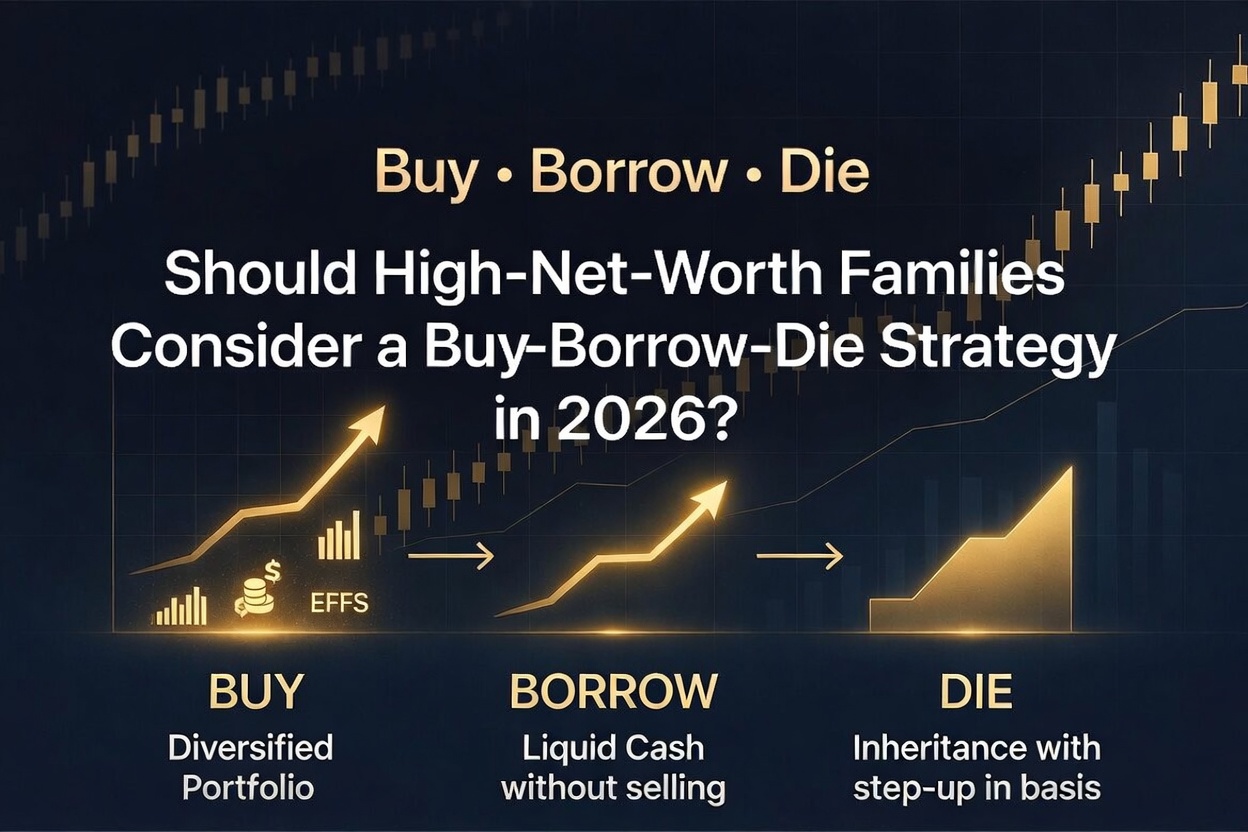
Should high-net-worth families consider a Buy-Borrow-Die strategy in 2026?

High-net-worth families often search for ways to access the value in their portfolios without triggering large capital gains taxes or eroding the wealth they’ve worked decades to build. One approach that surfaces frequently in sophisticated planning conversations is the so-called Buy-Borrow-Die strategy.
What Exactly Is the Buy-Borrow-Die Strategy?
In my experience after decades managing capital at Coca-Cola, Motorola, and AMP, the core idea is straightforward and built directly into the current U.S. tax code. You purchase appreciating assets (typically a diversified portfolio of stocks, bonds, or other investments), borrow against those assets when liquidity is needed rather than selling them, and ultimately allow the assets to pass to heirs who receive a step-up in basis at death.
Because loan proceeds are not considered taxable income, this sequence can help families enjoy the benefits of their wealth during life while minimizing or deferring capital gains taxes. At death, the stepped-up basis often resets the cost basis to fair market value, potentially eliminating the tax on lifetime appreciation for heirs.
How the Strategy Works in Practice
Here’s the three-step framework:
- Buy — Build and hold a portfolio of assets expected to appreciate over time within a thoughtfully allocated, risk-managed framework.
- Borrow — When cash flow is required for lifestyle, opportunities, or other needs, utilize a securities-backed line of credit (often called a pledged asset line or SBLOC) instead of selling holdings. Interest rates are typically lower than credit cards or unsecured loans, and the underlying assets continue to grow.
- Die — Assets pass to heirs with a step-up in basis under current law (IRC §1014). Heirs can then sell at the new basis with little or no capital gains tax on the pre-death appreciation.
With the federal estate tax exemption permanently increased to $15 million per individual ($30 million for married couples) beginning in 2026 and indexed for inflation thereafter, this strategy becomes even more relevant for many affluent families whose estates fall below the threshold.
Potential Benefits for High-Net-Worth Families
When implemented thoughtfully, the strategy can support several important objectives:
- Preservation of compound growth by avoiding forced sales and capital gains taxes.
- Tax-efficient liquidity without disrupting the portfolio’s long-term allocation.
- Enhanced legacy value through the step-up in basis, helping more wealth transfer to the next generation.
- Coordination with broader estate planning, charitable goals, and retirement income sequencing.
In the institutional environments I worked in, we applied similar disciplined capital-allocation principles — always weighing the after-tax, risk-adjusted outcomes rather than chasing any single tactic.
Important Considerations and Risks
Like any advanced strategy, Buy-Borrow-Die is not appropriate for every family and carries real trade-offs. Interest on the borrowed funds is a genuine cost (though often partially offset by continued portfolio growth). Market volatility can affect borrowing capacity and collateral requirements. Variable interest rates introduce uncertainty, and over-leveraging can amplify downside risk.
Additionally, tax laws can change. While the step-up in basis remains intact today, future legislative shifts are always possible. The strategy also requires careful coordination among your investment advisor, CPA, and estate planning attorney to ensure it aligns with your overall financial picture, cash-flow needs, and family objectives.
For families with more modest portfolios or shorter time horizons, simpler tax-efficient approaches — such as strategic Roth conversions, HSA maximization, or optimized withdrawal sequencing — may deliver greater net benefit without the added complexity or leverage.
When It Might Make Sense — And When It Might Not
In my work with high-net-worth clients, we evaluate this approach only after building a comprehensive financial infrastructure: a clear risk-managed portfolio, sufficient liquidity buffers, diversified holdings, and alignment with long-term legacy goals. It is one potential tool within a broader, fiduciary-driven plan — never a standalone solution.
The key question is whether the after-tax, after-cost, risk-adjusted outcome truly improves your family’s position compared with other legitimate planning levers.
Alex Boemark, CEO and Founder, Fountain Hills, Arizona. Fee-only fiduciary. Direct access to Alex. Arizona-based, serving families nationwide.
